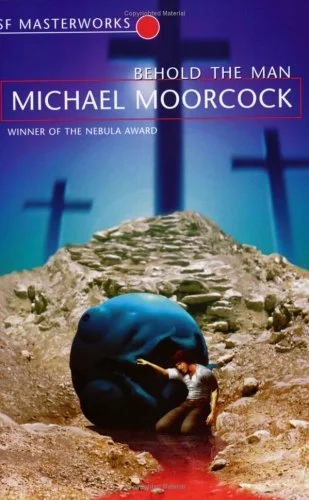
Behold The Man by Michael Moorcock (1969)
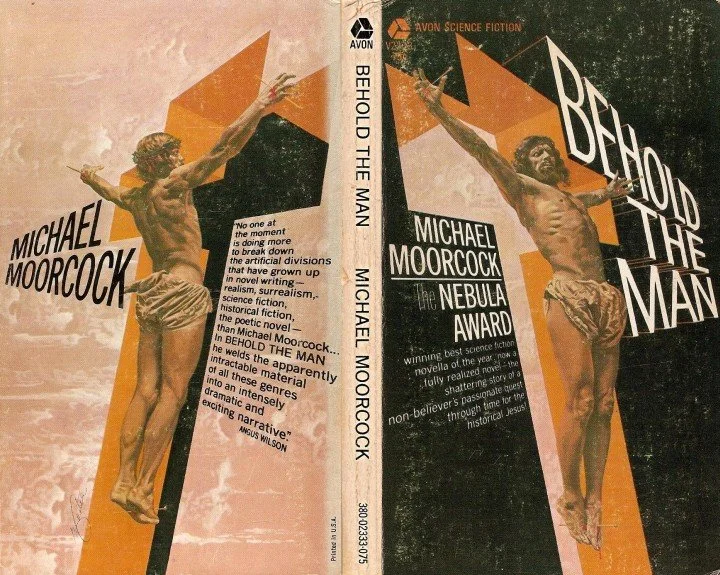
1970 cover art by Robert Foster
Karl Gloguar has left 1970 via chronological translocation and arrives in A.D. 28 on the outskirts of Nazareth. His goal isn’t to simply witness the crucifixion, but to first seek out Jesus himself for absolute affirmation of his existence in biblical history. Clocking in at 160 pages, it may not be a lengthy literary masterpiece, but the story deserves recognition because Moorcock brought an idea (time travel to the time of Christ) that has undoubtedly been floated before, to detailed life in novel form. Secondly, I love sci-fi that skews biblical history. The brief descriptions of both his arrival and his time machine drew me in from the start. Emerging from a cracked and damaged sphere of liquid, I wish there was more mention of the voyage itself and the inner workings of his vessel.
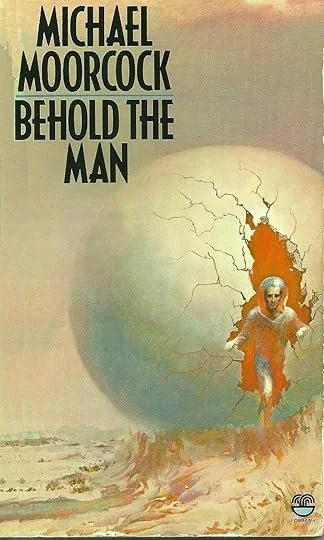
“The time machine is a sphere full of milky fluid in which the traveler floats enclosed in a rubber suit, breathing through a mask attached to a hose leading into the wall of the machine. The sphere cracks as it lands, and the spilled fluid is soaked up by the dust…”
1980 cover art by Walter Wyles
Shortly after crawling out of his ‘egg’ he is rescued by men wearing dirty sheepskin loincloths, sandals, dark-skinned and bearded, all signs that he has indeed arrived in the Middle East. He is carried away on a crude stretcher, in and out of consciousness and babbling incoherently. He starts to experience brief moments of clarity in his new surroundings, interspersed with flashbacks of childhood memories. He breaks through to the men using what little broken Aramaic he remembers, pinpointing his location to Machaerus, southeast of Jerusalem across from the Dead Sea.
He eventually meets converses with a man named John, who he realizes is ‘the’ John the Baptist, who notices in Karl the peculiarities of someone not of this world, giving John fuel to elevate Karl’s supernatural arrival and heralding his presence as a gift from Adonia, or God, from the Jewish bible. Someone so out of place and bizarre that his mere presence cannot be truly explained, he is a bit of an enigma. Karl deduces that according to the New Testament John the Baptist had been killed sometime before Christ’s crucifixion, roughly a year before, so he knows he hasn’t missed it. However, John has not heard of Jesus of Nazareth. Karl chooses to call himself Emmanuel, or “God with us” in Hebrew.
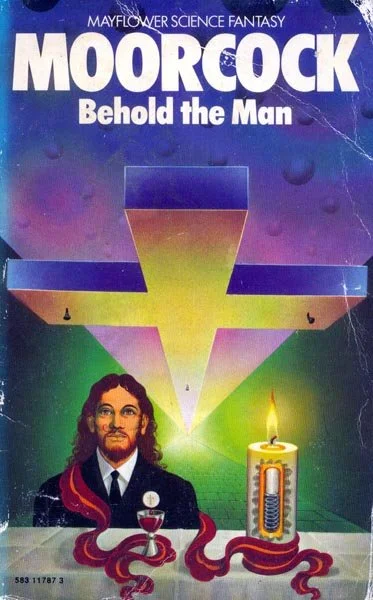
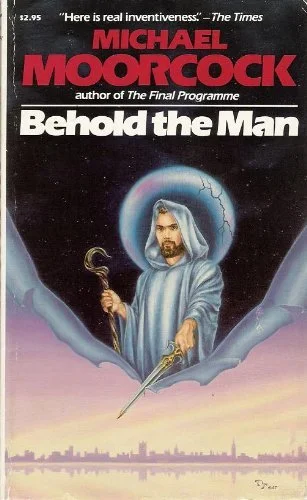
1970 cover art by Bob Haberfield
Karl starts to live a messianic lifestyle, a cross between a vagabond and magus, word of his arrival from a ‘chariot in the sky’ spreads. He eventually takes up residence in a synagogue, where his transition to being known as a messiah takes true shape due to his descriptions of future events as well as his periodic outbursts in an ‘alien’ (English) language. During his messianic wanderings he even starts ‘curing’ people, but he knows the ones he’s helping are in actuality experiencing psychosomatic conditions. His reputation as a prophet is further propelled by his prediction of the arrest of John the Baptist. When he comes to terms with the fact that he will never return home, Karl embraces what he is becoming in the eyes of the locals and he leans into it. A gift from above sent to liberate the people from the Roman Empire and the monarchy of King Herod.

“But it was not his own life he would be leading now. He was bringing a myth to life a generation before that myth would be born. He was completing a certain kind of psychic circuit. He told himself that he was not changing history; he was merely giving history more substance”.
1972 cover art by Jos Looman
When seeking out Jesus in the town of Nazareth, Karl starts by asking around for a carpenter named Joseph. He is led to a somewhat destitute neighborhood where he indeed finds Joseph, Mary and the child Jesus. However, what he discovers shatters everything he’s ever known, read, or been taught about Jesus of Nazareth. So much so, that he decides to make his own history.
Moorcock’s interwoven timelines make me think of Karl’s own sufferings as a weird parallel to the sufferings of Christ in some way. To put it plainly, thoughts of “Why me…why have I been chosen?” start running through his head. Being picked on and antagonized by fellow schoolchildren, an abusive headmaster, his failed relationships, battles with depression and even a suicide attempt are revisited. When Karl is ultimately summoned by Roman authorities and faces Pontius Pilate for causing civil unrest he states, “I am the messiah that has come to destroy your masters”, thus sealing his fate in the same fashion as Jesus met his, hanging from a cross in Golgotha. Karl has created the crucifixion by following the story he now knows is fictitious, reenacting it to its painful completion.